
7 Powerful WHAT CAUSES LUNG CANCER? RISK FACTORS EXPLAINED
Lung cancer is one of the most common cancers worldwide and can affect both smokers and non-smokers. Understanding WHAT CAUSES LUNG CANCER? RISK FACTORS EXPLAINED is essential for recognizing the factors that increase the likelihood of developing the disease and taking steps to reduce the risk. Many people believe smoking is the only cause, but several environmental, occupational, genetic, and lifestyle factors also contribute. Individuals in Thrissur and elsewhere can benefit from learning about these risk factors to make informed health decisions and seek medical attention when necessary.
This guide explains WHAT CAUSES LUNG CANCER? RISK FACTORS EXPLAINED in detail, including the causes, symptoms, types, diagnosis, treatment options, and preventive measures. Whether you are concerned about your own health or looking for information for a loved one, this article provides a clear understanding of the condition.
What Is Lung Cancer
Lung cancer develops when abnormal cells in the lungs begin to grow uncontrollably. Instead of following the body’s normal cell cycle, these cells multiply rapidly and form tumors that interfere with healthy lung function.
If left untreated, lung cancer can spread to nearby tissues, lymph nodes, and other organs, making treatment more challenging. Early detection significantly improves treatment outcomes.
Understanding WHAT CAUSES LUNG CANCER? RISK FACTORS EXPLAINED
When discussing WHAT CAUSES LUNG CANCER? RISK FACTORS EXPLAINED, it is important to understand that lung cancer usually develops due to a combination of genetic changes and long-term exposure to harmful substances.
The DNA inside lung cells can become damaged over time. As this damage accumulates, normal cells lose control over their growth, eventually leading to cancer.
Although smoking remains the leading cause, many people who have never smoked also develop lung cancer because of other risk factors.
Major Causes of Lung Cancer
Smoking Tobacco
Smoking is the leading cause of lung cancer worldwide.
Cigarettes contain thousands of chemicals, many of which are known carcinogens. These harmful substances damage lung tissue with every inhalation.
Smoking-related risk increases with:
- Number of cigarettes smoked
- Years of smoking
- Age at which smoking began
- Depth of inhalation
Even occasional smoking increases risk.
Secondhand Smoke
People who regularly inhale smoke from others are also at increased risk.
Secondhand smoke contains many of the same cancer-causing chemicals found in directly inhaled cigarette smoke.
Living with smokers or working in smoke-filled environments can significantly increase lung cancer risk.
Radon Gas Exposure
Radon is a naturally occurring radioactive gas that can accumulate inside homes and buildings.
Since it is invisible and odorless, many people are unaware they are exposed.
Long-term radon exposure is one of the leading causes of lung cancer among non-smokers.
Air Pollution
Long-term exposure to polluted air can contribute to lung cancer.
Common sources include:
- Vehicle emissions
- Industrial pollution
- Burning fuels
- Construction dust
- Fine particulate matter
Living in highly polluted areas increases continuous exposure to harmful particles.
Occupational Exposure
Certain professions involve regular exposure to hazardous substances.
Examples include:
- Asbestos
- Silica dust
- Diesel exhaust
- Arsenic
- Chromium
- Nickel
- Coal dust
Workers should always follow workplace safety guidelines and use protective equipment.
Genetic Factors
Some individuals inherit genetic mutations that increase their susceptibility to lung cancer.
A family history of lung cancer may increase the likelihood of developing the disease even without smoking.
Genetics alone rarely causes lung cancer but can make people more vulnerable when combined with environmental exposures.
Previous Radiation Therapy
Radiation therapy to the chest for other cancers may slightly increase the future risk of lung cancer.
The risk depends on:
- Radiation dose
- Age during treatment
- Smoking history
- Overall health
Chronic Lung Diseases
Certain lung conditions increase long-term inflammation, which may contribute to cancer development.
Examples include:
- COPD
- Pulmonary fibrosis
- Tuberculosis-related lung scarring
Proper management of chronic lung diseases may reduce complications.
Common Risk Factors
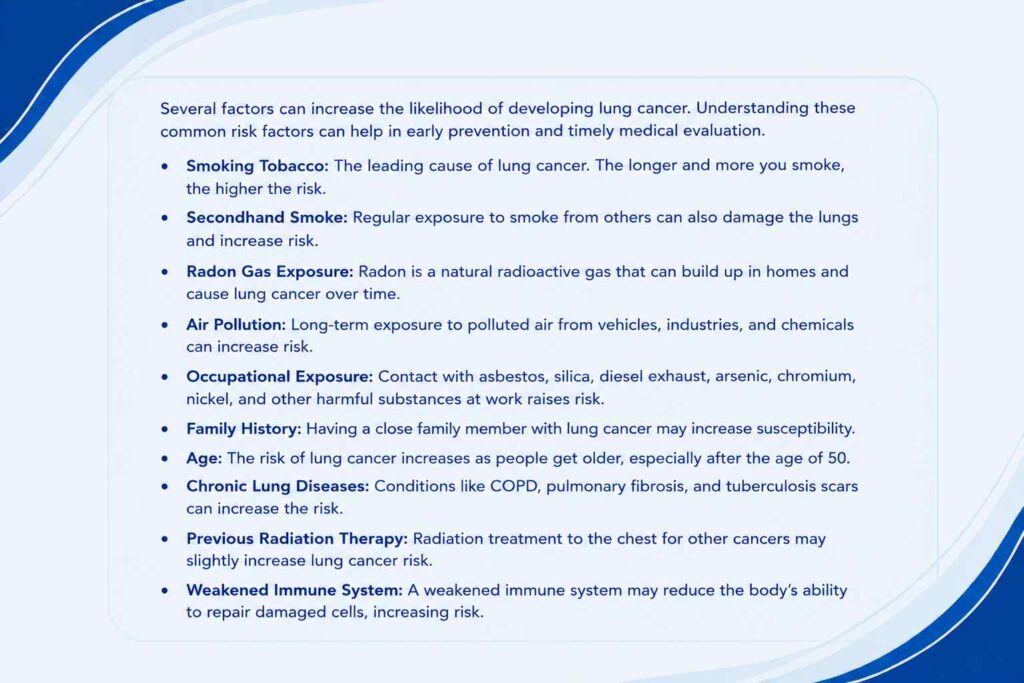
Understanding WHAT CAUSES LUNG CANCER? RISK FACTORS EXPLAINED also means recognizing the factors that increase risk.
Important risk factors include:
- Smoking
- Passive smoking
- Older age
- Family history
- Radon exposure
- Air pollution
- Occupational chemicals
- Previous chest radiation
- Chronic lung disease
- Weakened immune system
Having one or more risk factors does not guarantee lung cancer, but it increases the likelihood.
Can Non-Smokers Develop Lung Cancer
Yes.
Many people diagnosed with lung cancer have never smoked.
Common causes among non-smokers include:
- Radon gas
- Air pollution
- Workplace exposure
- Family history
- Genetic mutations
- Secondhand smoke
This is why everyone should understand WHAT CAUSES LUNG CANCER? RISK FACTORS EXPLAINED, regardless of smoking history.
Types of Lung Cancer
There are two primary categories of lung cancer.
Non-Small Cell Lung Cancer (NSCLC)
This is the most common type, accounting for approximately 85% of lung cancer cases.
Subtypes include:
- Adenocarcinoma
- Squamous cell carcinoma
- Large cell carcinoma
NSCLC generally grows more slowly than small cell lung cancer.
Small Cell Lung Cancer (SCLC)
Small cell lung cancer grows rapidly and often spreads early.
It is strongly associated with heavy smoking and usually requires prompt treatment.
Early Symptoms of Lung Cancer
Symptoms may not appear during the early stages.
As the disease progresses, common symptoms include:
- Persistent cough
- Chest pain
- Shortness of breath
- Wheezing
- Coughing up blood
- Fatigue
- Unexplained weight loss
- Hoarseness
- Frequent lung infections
- Bone pain (advanced stages)
Anyone experiencing persistent symptoms should seek medical evaluation promptly.
Diagnosis of Lung Cancer
Early diagnosis plays a vital role in improving treatment outcomes. When symptoms or risk factors suggest the possibility of lung cancer, healthcare providers use a combination of imaging tests, laboratory investigations, and tissue sampling to confirm the diagnosis.
Medical History and Physical Examination
The first step is a detailed discussion about:
- Smoking history
- Family history of cancer
- Occupational exposure
- Existing lung diseases
- Current symptoms
A physical examination helps identify signs that may require further investigation.
Chest X-ray
A chest X-ray is often the initial imaging test used to detect abnormalities in the lungs. Although it cannot confirm cancer, it can identify suspicious masses or lung changes that require additional evaluation.
CT Scan
A Computed Tomography (CT) scan provides detailed cross-sectional images of the lungs.
It helps doctors:
- Detect small lung nodules
- Assess tumor size
- Identify enlarged lymph nodes
- Evaluate whether cancer has spread
Low-dose CT screening is often recommended for individuals at high risk of lung cancer.
PET Scan
A Positron Emission Tomography (PET) scan helps determine whether abnormal lung tissue is cancerous and whether the disease has spread to other organs.
MRI Scan
Magnetic Resonance Imaging (MRI) may be recommended if there is concern that lung cancer has spread to the brain or spinal cord.
Bronchoscopy
During bronchoscopy, a thin flexible tube with a camera is inserted through the nose or mouth into the lungs.
This procedure allows specialists to:
- Examine the airways
- Collect tissue samples
- Detect abnormalities
Biopsy
A biopsy is the most reliable way to confirm lung cancer.
Small tissue samples may be collected using:
- Bronchoscopy
- Needle biopsy
- CT-guided biopsy
- Surgical biopsy
The sample is examined under a microscope to determine the type of lung cancer.
Molecular Testing
Some lung cancers contain specific genetic mutations.
Molecular testing helps identify these mutations, allowing doctors to choose targeted therapies that may improve treatment outcomes.
Stages of Lung Cancer
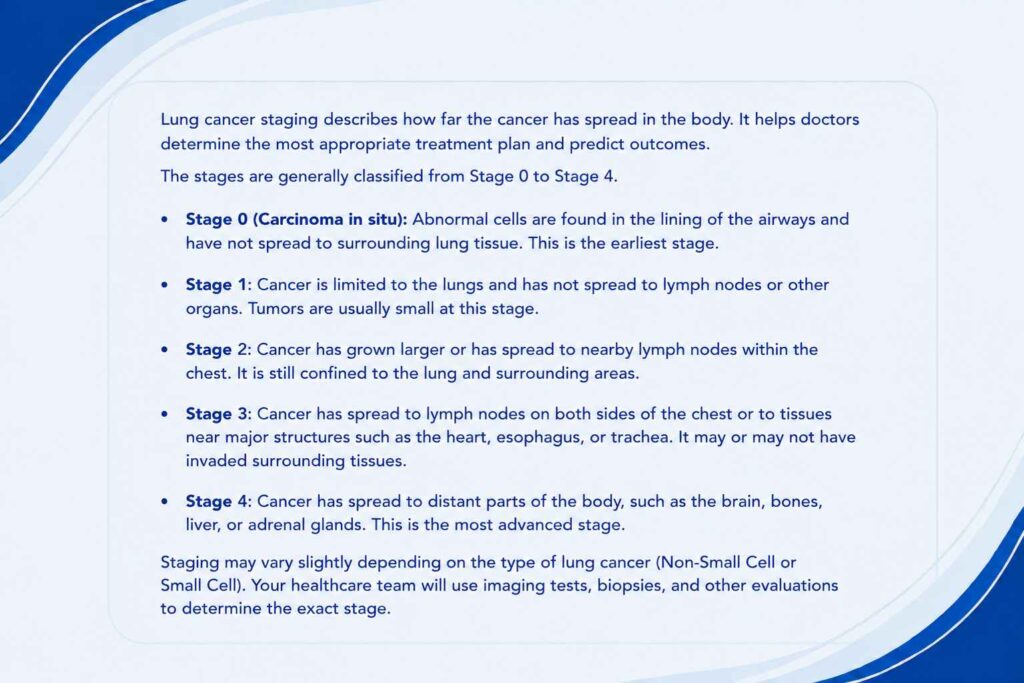
Understanding the stage of lung cancer helps determine the most appropriate treatment plan.
Stage 1
- Cancer is confined to the lung.
- It has not spread to lymph nodes.
- Surgery often offers excellent outcomes.
Stage 2
- Cancer may have spread to nearby lymph nodes.
- Treatment often combines surgery with chemotherapy.
Stage 3
- Cancer has spread further within the chest.
- Multiple treatment approaches may be needed.
Stage 4
- Cancer has spread to distant organs.
- Treatment focuses on controlling disease, improving quality of life, and extending survival.
Treatment Options for Lung Cancer
Treatment depends on several factors, including:
- Type of lung cancer
- Stage of disease
- Overall health
- Age
- Genetic characteristics of the tumor
Surgery
Surgery is usually recommended when lung cancer is detected early.
Common surgical procedures include:
- Wedge resection
- Segmentectomy
- Lobectomy
- Pneumonectomy
The goal is to remove the cancer while preserving as much healthy lung tissue as possible.
Radiation Therapy
Radiation therapy uses high-energy rays to destroy cancer cells.
It may be used:
- Before surgery
- After surgery
- As the main treatment
- To relieve symptoms in advanced cancer
Chemotherapy
Chemotherapy uses medicines that kill rapidly dividing cancer cells.
It may be recommended:
- Before surgery
- After surgery
- Along with radiation therapy
- For advanced-stage lung cancer
Targeted Therapy
Some lung cancers have specific genetic changes that respond to targeted medicines.
Targeted therapy attacks cancer cells while minimizing damage to healthy tissues.
Immunotherapy
Immunotherapy strengthens the body’s immune system so it can recognize and attack cancer cells more effectively.
This treatment has improved outcomes for many patients with advanced lung cancer.
Palliative Care
Palliative care focuses on improving comfort and quality of life.
It helps manage symptoms such as:
- Pain
- Breathing difficulty
- Fatigue
- Anxiety
- Loss of appetite
Palliative care can be provided alongside active cancer treatment.
Can Lung Cancer Be Prevented
Although not every case can be prevented, many risk factors can be reduced.
Preventive measures include:
- Avoid smoking
- Quit tobacco use as early as possible
- Stay away from secondhand smoke
- Test homes for radon gas
- Use protective equipment at work
- Reduce exposure to air pollution
- Maintain a healthy lifestyle
- Exercise regularly
- Eat a balanced diet
- Attend regular health check-ups if at high risk
Lifestyle Tips to Support Lung Health
Healthy habits contribute to better lung function and overall well-being.
Helpful lifestyle practices include:
Eat a Nutritious Diet
Choose foods rich in:
- Fruits
- Vegetables
- Whole grains
- Lean protein
- Healthy fats
Stay Physically Active
Regular exercise improves lung capacity, heart health, and overall fitness.
Aim for at least 150 minutes of moderate physical activity each week.
Avoid Smoking
Quitting smoking remains one of the most effective ways to lower the risk of lung cancer.
Even long-term smokers benefit from quitting.
Protect Yourself at Work
If you work around chemicals or dust, always:
- Wear protective masks
- Follow safety protocols
- Attend workplace health screenings
Schedule Regular Screening
Individuals at high risk should discuss lung cancer screening with their healthcare provider.
Early detection significantly improves treatment success.
Why Early Detection Matters
Lung cancer often develops silently during its early stages.
When detected early:
- Treatment options are more effective
- Surgery is more likely to be possible
- Survival rates improve
- Complications decrease
- Recovery may be faster
Regular screening for high-risk individuals can make a substantial difference.
Conclusion
Understanding WHAT CAUSES LUNG CANCER? RISK FACTORS EXPLAINED empowers people to recognize potential dangers and make healthier choices. While smoking remains the leading cause, lung cancer can also result from secondhand smoke, radon exposure, air pollution, occupational hazards, genetic factors, and chronic lung diseases. Knowing these risk factors allows individuals to reduce avoidable risks, seek timely medical evaluation, and benefit from early diagnosis and treatment.
By adopting healthy lifestyle habits, avoiding tobacco, protecting yourself from harmful environmental exposures, and remaining aware of warning signs, you can take proactive steps toward better lung health. Staying informed about WHAT CAUSES LUNG CANCER? RISK FACTORS EXPLAINED is an important part of protecting yourself and your family. Whether you live in Thrissur or elsewhere, awareness and early action can play a significant role in improving long-term health outcomes. For additional evidence-based information about lung cancer causes, risk factors, diagnosis, and treatment, visit the National Cancer Institute (NCI) .
Frequently Asked Questions

Dr. Bibin Francis
Dr. Bibin Francis is a dedicated medical oncologist with expertise in chemotherapy, immunotherapy, targeted therapy, and personalized cancer treatment planning for a wide range of malignancies.
Jubilee Mission Medical College & Research Institute, Thrissur, Kerala