
Lung Cancer Surgery: 7 Essential Facts About When It Is Used
Lung cancer surgery is one of the main treatment options for certain people diagnosed with lung cancer, particularly when the cancer is found at an early stage and remains confined to the lung. For patients receiving evaluation and treatment in Thrissur, understanding when surgery may be recommended can make discussions about treatment options clearer and more informed.
However, surgery is not suitable for every person with lung cancer. Doctors consider the type of lung cancer, its stage, tumor location, lymph node involvement, overall health, lung function, and whether the cancer has spread to other parts of the body.
The primary objective of lung cancer surgery is usually to remove the cancer completely while preserving as much healthy lung tissue and function as possible. Depending on the individual situation, surgery may involve removing a small section of the lung, an entire lobe, or occasionally an entire lung.
This guide explains when lung cancer surgery is recommended, the types of surgery available, factors affecting eligibility, potential benefits, risks, preparation, and recovery.
What Is Lung Cancer Surgery
Lung cancer surgery is a treatment that involves physically removing cancerous tissue from the lung. It is most commonly considered when the tumor is localized and doctors believe that it can be completely removed.
Surgery is particularly important in the treatment of selected cases of non-small cell lung cancer (NSCLC). It is less commonly performed for small cell lung cancer because this form of cancer often spreads relatively early.
The amount of lung tissue removed depends on several factors, including:
- Size of the tumor
- Location of the tumor
- Lung cancer stage
- Involvement of nearby lymph nodes
- Patient’s overall health
- Existing lung function
- Presence of other medical conditions
- Whether cancer has spread outside the lung
Before recommending an operation, the medical team usually performs detailed investigations to determine whether surgery offers an appropriate balance of potential benefit and risk.
When Is Lung Cancer Surgery Recommended
Lung cancer surgery is generally recommended when doctors believe the cancer can be completely removed and the patient is medically fit enough to tolerate the operation.
Surgery is most frequently considered for early-stage non-small cell lung cancer. This commonly includes stage I and stage II disease and selected stage III cancers.
Early-Stage Lung Cancer
Early-stage lung cancer means that the cancer remains relatively localized. When the tumor has not spread to distant organs, surgical removal may provide an opportunity for long-term disease control and, in some cases, cure.
Localized Tumors
A tumor that is confined to one lung and can be removed with clear surgical margins may be considered suitable for surgery.
Limited Lymph Node Involvement
Nearby lymph nodes are carefully evaluated before treatment. Some patients with limited regional lymph node involvement may still be candidates for surgery, often as part of a broader treatment plan involving chemotherapy, immunotherapy, or radiation therapy.
Adequate Lung Function
Removing lung tissue reduces the amount of functioning lung remaining after surgery. Pulmonary function testing therefore helps determine whether a person is likely to have sufficient respiratory capacity following the procedure.
Good Overall Health
Major lung surgery places stress on the heart, lungs, and body. A patient’s cardiovascular health, nutritional condition, physical fitness, and other medical problems are therefore considered before an operation.
Why Lung Cancer Stage Matters Before Surgery
Cancer staging is one of the most important factors in determining whether lung cancer surgery is appropriate.
Staging describes how large the cancer is, whether nearby lymph nodes are affected, and whether cancer cells have spread to distant organs.
Stage I Lung Cancer
Stage I non-small cell lung cancer is confined to the lung without spread to lymph nodes or distant organs.
Surgery is commonly considered for medically fit patients at this stage.
Stage II Lung Cancer
Stage II disease may involve a larger tumor, nearby structures, or certain nearby lymph nodes.
Surgery may still be recommended if doctors believe the cancer can be completely removed.
Stage III Lung Cancer
Stage III lung cancer is more complex because the disease may involve lymph nodes or nearby structures.
Some carefully selected patients may undergo surgery, but treatment frequently involves combinations of chemotherapy, radiation therapy, immunotherapy, and surgery.
Stage IV Lung Cancer
Stage IV lung cancer has spread to distant parts of the body.
Because surgery treats a specific local area rather than cancer throughout the body, surgery is generally not the primary treatment for widespread metastatic lung cancer. However, highly selected patients with limited metastatic disease may sometimes be evaluated for local treatments as part of an individualized plan.
Types of Lung Cancer Surgery
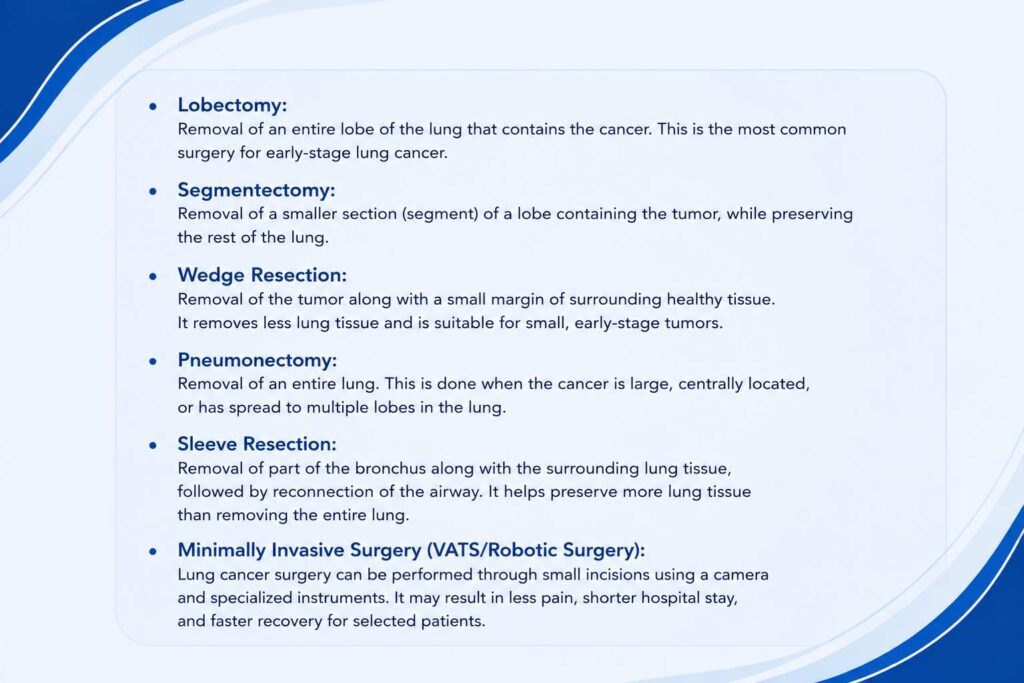
Different surgical procedures can be used depending on the tumor’s size and location and the amount of healthy lung tissue that can safely be preserved.
Lobectomy
The lungs are divided into sections called lobes. The right lung contains three lobes, while the left lung contains two.
A lobectomy removes the entire lobe containing the tumor.
It is a commonly performed operation for localized non-small cell lung cancer when the patient has adequate lung function.
Segmentectomy
A segmentectomy removes an anatomical segment of a lung lobe containing the cancer while preserving the remainder of that lobe.
It may be considered for selected small, early-stage tumors and for patients in whom preserving healthy lung tissue is particularly important.
Wedge Resection
A wedge resection removes the tumor together with a small margin of surrounding healthy tissue.
It removes less lung tissue than a lobectomy and may be considered in selected patients with small peripheral tumors or reduced pulmonary reserve.
Pneumonectomy
A pneumonectomy involves removing an entire lung.
This procedure may be necessary when a tumor is centrally located or extends across areas that cannot be adequately removed with a smaller operation.
Because an entire lung is removed, careful evaluation of heart and lung function is particularly important.
Sleeve Resection
A sleeve resection may be used when a tumor affects a major airway.
The affected section of the bronchus and lung tissue is removed, and the remaining airway is reconnected. In suitable cases, this approach may help preserve more functioning lung tissue than removing the whole lung.
Tests Before Lung Cancer Surgery
Several investigations may be performed before lung cancer surgery. These tests help determine the cancer stage and whether the patient can safely undergo an operation.
Imaging Tests
A CT scan provides detailed images of the lungs and surrounding structures.
PET-CT imaging may also be used to identify areas of increased metabolic activity that could represent cancer in lymph nodes or other parts of the body.
Brain imaging may be recommended in certain situations to check for possible spread.
Biopsy
A biopsy provides tissue that can be examined under a microscope to determine the type of lung cancer.
Biopsy techniques may include bronchoscopy, needle biopsy, or other procedures depending on where the abnormality is located.
Lymph Node Evaluation
Checking lymph nodes helps determine whether cancer has spread beyond the primary tumor.
Techniques such as endobronchial ultrasound-guided biopsy, mediastinoscopy, or surgical lymph node sampling may be used when appropriate.
Pulmonary Function Tests
Pulmonary function tests measure how effectively the lungs work.
These results help estimate whether enough respiratory capacity will remain after removing part of the lung.
Heart Assessment
Some patients require an electrocardiogram, echocardiogram, exercise testing, or other cardiovascular investigations before major surgery.
Who May Not Be Suitable for Lung Cancer Surgery
Not every person diagnosed with lung cancer will benefit from surgery.
Lung cancer surgery may not be recommended when the potential risks outweigh the expected benefits or when the cancer cannot be completely removed surgically.
Factors that may affect suitability include:
- Cancer that has spread extensively
- Tumors that cannot be safely removed
- Extensive lymph node involvement
- Severely reduced lung function
- Serious cardiovascular disease
- Poor general physical condition
- Medical conditions that significantly increase surgical risk
Being unsuitable for surgery does not mean that treatment is unavailable. Radiation therapy, chemotherapy, targeted therapy, immunotherapy, or combinations of treatments may be considered depending on the cancer type and molecular characteristics.
Benefits of Lung Cancer Surgery
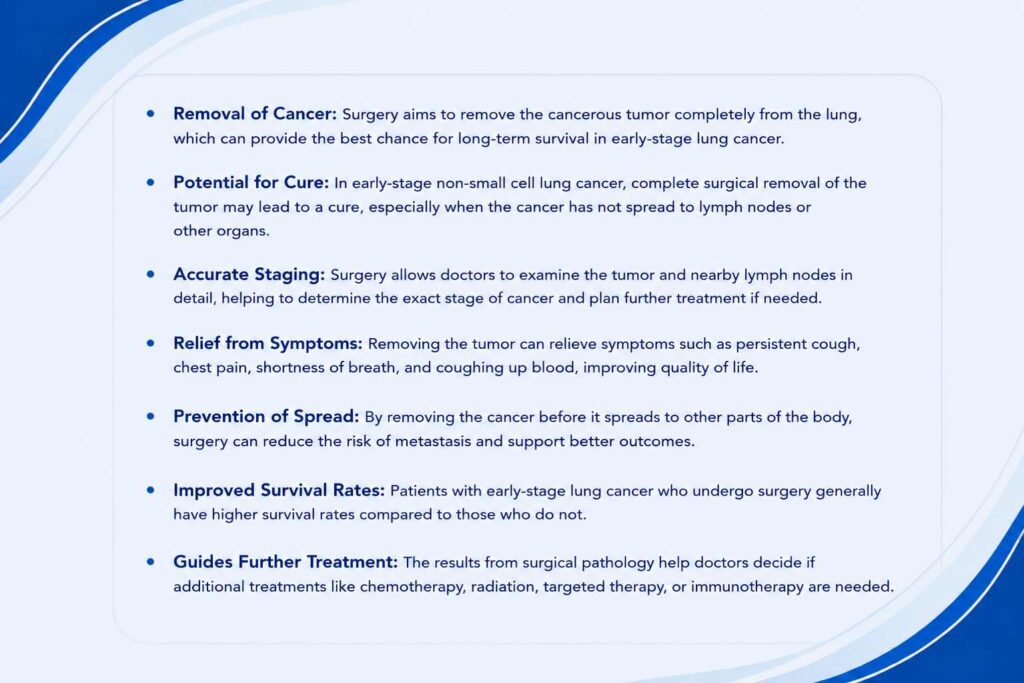
The main potential benefit of lung cancer surgery is the removal of localized cancer from the body.
For appropriately selected patients, potential benefits include:
- Complete removal of a localized tumor
- Potential for long-term cancer control
- Possibility of cure in certain early-stage cancers
- Removal of nearby affected lymph nodes
- Accurate pathological staging
- More detailed information about the tumor
- Guidance for additional treatment decisions
After surgery, the removed tumor and lymph nodes can be examined by a pathologist. This provides detailed information about the cancer and may reveal whether additional treatment is appropriate.
Risks and Possible Complications
Like any major operation, lung cancer surgery has potential risks.
The likelihood of complications varies depending on the procedure, age, general health, smoking history, heart function, and existing lung function.
Possible complications include:
- Bleeding
- Infection
- Pneumonia
- Blood clots
- Persistent air leakage from the lung
- Abnormal heart rhythm
- Breathing difficulties
- Pain around the surgical area
- Reactions to anesthesia
Before surgery, the healthcare team evaluates these risks and explains how they relate to the individual patient’s condition.
Open and Minimally Invasive Lung Cancer Surgery
Lung operations can be performed through different surgical approaches.
Open Thoracic Surgery
Traditional open surgery is known as thoracotomy.
During a thoracotomy, an incision is made between the ribs to provide direct access to the lung. Open surgery may be necessary for large or complex tumors or when minimally invasive surgery is unsuitable.
Video-Assisted Thoracoscopic Surgery
Video-assisted thoracoscopic surgery, commonly called VATS, uses small incisions and a camera to allow the surgeon to operate inside the chest.
For suitable patients, this minimally invasive approach may result in less postoperative discomfort and a shorter recovery period than conventional open surgery.
Robotic-Assisted Surgery
Robotic-assisted thoracic surgery is another minimally invasive approach. The surgeon controls robotic instruments that allow precise movements within the chest.
The appropriate surgical technique depends on tumor characteristics, patient factors, surgical expertise, and available facilities.
Preparing for Lung Cancer Surgery
Preparation is an important part of lung cancer surgery.
Patients may receive instructions about medications, eating and drinking, physical activity, and smoking cessation.
If a person currently smokes, stopping before surgery can improve lung function and reduce certain postoperative complications.
Preparation may include:
- Completing blood tests
- Reviewing current medications
- Pulmonary function testing
- Heart evaluation when required
- Improving nutrition
- Increasing physical activity when medically appropriate
- Practicing breathing exercises
- Stopping smoking
- Discussing anesthesia
- Planning postoperative support
Patients should tell their healthcare team about prescription medications, over-the-counter medicines, vitamins, supplements, and allergies.
What Happens During Lung Cancer Surgery
The exact process depends on the type of operation being performed.
Most major lung operations are carried out under general anesthesia. This means the patient remains unconscious during the procedure.
The surgeon accesses the chest through an open incision or minimally invasive ports. The tumor and planned amount of lung tissue are then removed.
Nearby lymph nodes are commonly removed or sampled. Examining these lymph nodes provides valuable information about the stage of the cancer.
After the required tissue has been removed, one or more chest tubes may be placed. These tubes help drain fluid and air from around the lung while it heals.
Recovery After Lung Cancer Surgery
Recovery following lung cancer surgery varies considerably between patients.
The type of operation is an important factor. Someone undergoing a small minimally invasive resection may recover differently from a person undergoing open pneumonectomy.
Immediately after surgery, healthcare professionals monitor:
- Breathing
- Oxygen levels
- Blood pressure
- Heart rate
- Surgical wounds
- Chest tube drainage
- Pain levels
Pain management is important because controlling discomfort allows patients to breathe deeply, cough effectively, and move around.
Early movement can also reduce the risk of blood clots and other complications.
Breathing Exercises
Deep breathing exercises and incentive spirometry may be recommended after surgery.
These exercises help expand the lungs and reduce the risk of postoperative respiratory complications.
Returning to Normal Activities
Activity is usually increased gradually.
Patients should follow individualized advice about walking, driving, lifting heavy objects, returning to work, and exercise.
Treatment After Lung Cancer Surgery
Surgery may be only one component of lung cancer treatment.
After the removed tissue is examined, doctors receive a final pathological stage. The results help determine whether additional treatment is advisable.
Chemotherapy
Chemotherapy may be recommended after surgery for certain cancers to reduce the risk of recurrence.
Targeted Therapy
Some non-small cell lung cancers contain specific genetic alterations that can be treated with targeted medicines.
Molecular testing can help determine whether a tumor has an actionable alteration.
Immunotherapy
Immunotherapy helps the immune system recognize and attack cancer cells. Selected patients may receive immunotherapy before or after surgery depending on the cancer’s characteristics and stage.
Radiation Therapy
Radiation therapy is not routinely required after every lung operation. It may be considered in particular situations based on surgical margins, lymph node involvement, or other pathological findings.
Follow-Up After Lung Cancer Surgery
Regular follow-up remains important after treatment.
Follow-up appointments allow healthcare professionals to assess recovery, manage ongoing symptoms, review imaging, and look for signs that cancer has returned or that another lung cancer has developed.
Follow-up may involve:
- Physical examinations
- Symptom assessment
- Chest CT scans
- Review of respiratory function
- Medication assessment
- Smoking cessation support
- Rehabilitation when required
Patients should report new or persistent symptoms rather than waiting until their next scheduled appointment.
Tips for Recovery After Surgery
Recovery takes time, and the pace differs from person to person.
Helpful measures may include:
- Follow postoperative instructions carefully.
- Take prescribed medicines as directed.
- Perform recommended breathing exercises.
- Increase walking and physical activity gradually.
- Avoid smoking and tobacco exposure.
- Eat balanced, nutritious meals.
- Maintain adequate hydration unless medically restricted.
- Keep surgical wounds clean as instructed.
- Attend scheduled follow-up appointments.
- Report concerning symptoms promptly.
Patients should seek medical advice for symptoms such as increasing breathlessness, significant bleeding, persistent fever, worsening chest pain, wound changes, or other unexpected problems.
Conclusion
Lung cancer surgery can play an important role in treating early and selected locally advanced non-small cell lung cancers. Surgery is generally recommended when the tumor can be completely removed and the patient’s heart, lungs, and overall health are strong enough for the planned operation.
Lobectomy, segmentectomy, wedge resection, sleeve resection, and pneumonectomy are among the procedures that may be considered. Accurate staging, imaging, lymph node assessment, pulmonary function testing, and overall medical evaluation are essential before making a surgical decision.
Treatment planning should always be individualized because two people with apparently similar lung cancers may require different approaches. For people seeking evaluation in Thrissur, discussing the cancer stage, surgical eligibility, expected benefits, possible risks, alternatives, and follow-up plan with the treating medical team can support informed decision-making. For reliable information about lung cancer treatment and surgery, visit the National Cancer Institute – Non-Small Cell Lung Cancer Treatment for evidence-based guidance on treatment options.
Frequently Asked Questions

Dr. Bibin Francis
Dr. Bibin Francis is a dedicated medical oncologist with expertise in chemotherapy, immunotherapy, targeted therapy, and personalized cancer treatment planning for a wide range of malignancies.
Jubilee Mission Medical College & Research Institute, Thrissur, Kerala