
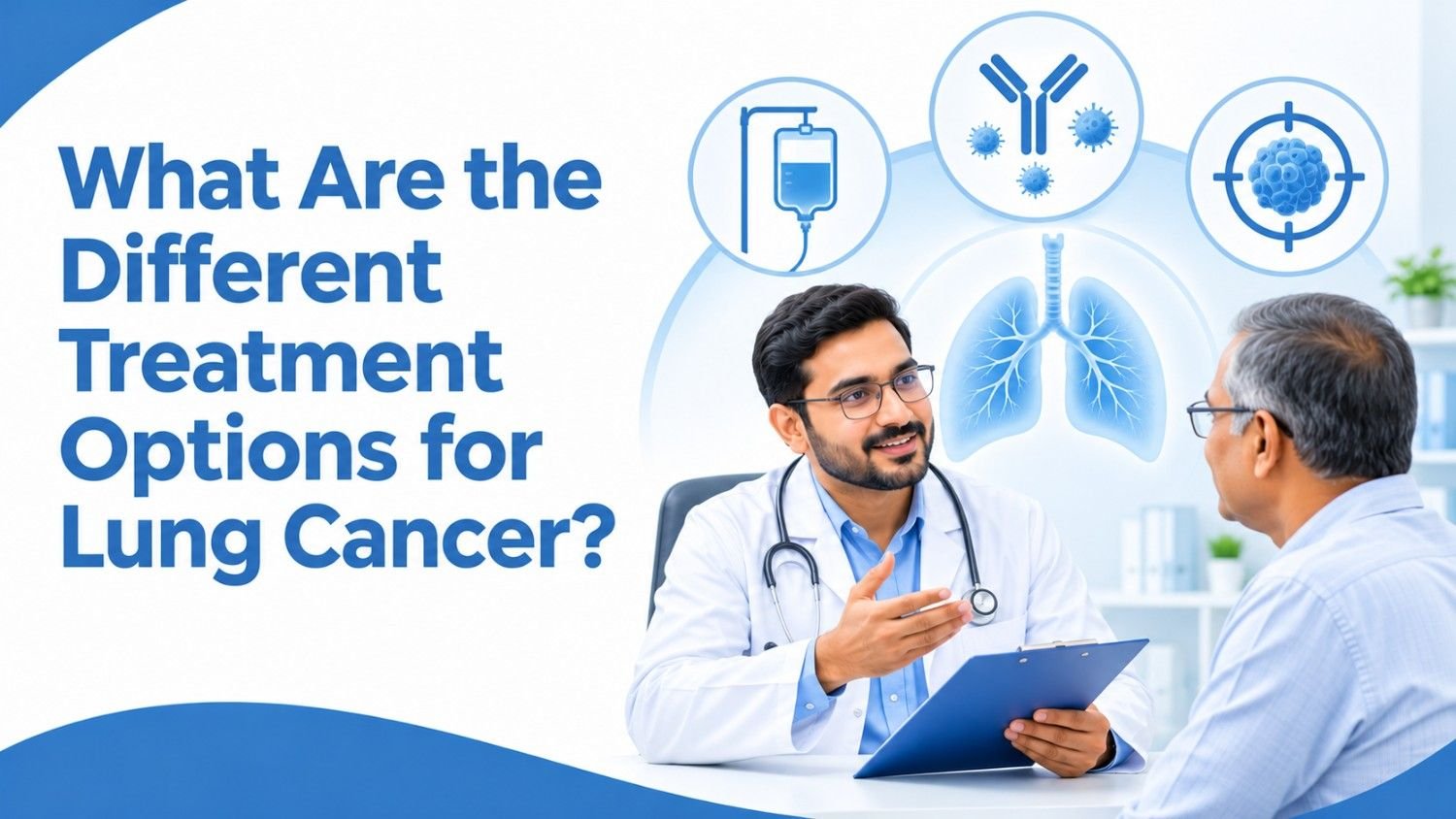
What Are the Different Treatment Options for Lung Cancer?
What Are the Different Treatment Options for Lung Cancer? This is an important question for people who have been diagnosed with lung cancer and for families who want to understand the available treatments. Lung cancer treatment has improved over the years, and several medical approaches can help control the disease, reduce symptoms and support a person’s quality of life. The right treatment depends on the type of cancer, its stage, the patient’s general health and certain features found in the cancer cells.
Lung cancer does not have one treatment that is suitable for everyone. Some patients may need surgery, while others may benefit from chemotherapy, radiation therapy, immunotherapy or targeted therapy. Doctors may also combine two or more treatments to achieve the best possible result. A medical oncologist helps patients understand these choices and develop a treatment plan based on their individual needs. Dr. Bibin Francis Medical Oncologist, In Thrissur whose areas of practice include lung cancer, chemotherapy, immunotherapy and targeted therapy.
Before discussing what are the different treatment options for lung cancer, it is helpful to understand that lung cancer is not just one disease. The two main types are non-small cell lung cancer (NSCLC) and small cell lung cancer (SCLC). Non-small cell lung cancer is the more common type. It includes different forms, such as adenocarcinoma and squamous cell carcinoma. Small cell lung cancer is less common and can grow and spread more quickly.
The type of lung cancer is identified by examining a sample of the tumour under a microscope. Doctors may also request additional tests to understand the cancer’s features. These results help the medical team decide which treatments are likely to work. For example, some non-small cell lung cancers may respond to targeted medicines if specific genetic changes are found. Small cell lung cancer is often treated with chemotherapy and radiation therapy, sometimes together with immunotherapy.
The stage of lung cancer describes how large the tumour is and whether it has spread to nearby lymph nodes or other parts of the body. Early-stage lung cancer may be limited to a small area of the lung. Locally advanced cancer may involve nearby structures or lymph nodes. Advanced lung cancer may have spread to distant organs. Doctors use scans, biopsies and other investigations to understand the stage before recommending treatment.
When families ask what are the different treatment options for lung cancer, the stage is one of the first factors doctors consider. Surgery may be suitable for some early-stage cancers. A combination of chemotherapy and radiation therapy may be recommended for certain locally advanced cancers. Advanced disease may be treated with medicines such as chemotherapy, targeted therapy or immunotherapy. These treatments may help control cancer growth and manage symptoms. The treatment plan is individualised rather than selected by stage alone.
Lung cancer surgery is an operation to remove the tumour and, when necessary, nearby lung tissue or lymph nodes. It is commonly considered for selected patients with early-stage non-small cell lung cancer when the cancer can be removed safely. The type of operation depends on the tumour’s size, position and the patient’s lung function. A lobectomy removes one lobe of the lung, while a segmentectomy removes a smaller section. A wedge resection removes the tumour along with a small area of surrounding tissue.
Not every patient with lung cancer can have surgery. The doctor must check whether the cancer can be removed completely and whether the patient’s heart and lungs can manage the operation. Some patients may receive chemotherapy, immunotherapy or another treatment before surgery to help manage the disease. Additional treatment may also be advised afterwards to reduce the risk of recurrence. Surgery is only one part of the wider range of lung cancer treatment options and is not appropriate for every cancer type or stage.
Chemotherapy uses medicines to destroy cancer cells or slow their growth. These medicines may be given through a vein or, in some cases, as tablets. They travel through the bloodstream and can reach cancer cells in different parts of the body. Chemotherapy may be used before surgery to help shrink a tumour, after surgery to lower the risk of cancer returning, or as a main treatment when surgery is not suitable. It is also commonly used for small cell lung cancer.
The number of chemotherapy sessions and the medicines selected depend on the patient’s condition and the cancer type. Treatment is usually given in cycles, with rest periods between sessions to allow the body to recover. Some people experience tiredness, nausea, reduced appetite, hair loss or a lower blood cell count. Not everyone has the same side effects, and supportive medicines can help manage many of them. Patients should report new or worsening symptoms to their oncology team rather than stopping treatment on their own.
Radiation therapy uses carefully directed high-energy rays to damage cancer cells and stop them from growing. It can be used as the main treatment for some patients who cannot undergo surgery. It may also be combined with chemotherapy for certain locally advanced lung cancers. In other situations, radiation is given after surgery or used to manage symptoms caused by cancer that has spread to areas such as the bones or brain.
The treatment team plans the radiation carefully to focus on the tumour while limiting exposure to nearby healthy tissues. The number of sessions depends on the treatment goal, the tumour’s location and the technique being used. Possible side effects include tiredness, skin changes, cough or irritation in the food pipe, depending on the area treated. The radiation oncologist explains the expected benefits and risks before treatment begins. Radiation therapy may be used alone or as one part of a combined treatment plan.
Targeted therapy uses medicines that act on particular changes or proteins that help cancer cells grow. Some lung cancers have specific genetic changes, often called mutations or alterations. Examples include changes involving EGFR, ALK, ROS1 and other cancer-related markers. If testing identifies a change that can be treated with an approved targeted medicine, the oncologist may consider this approach. Many targeted medicines are taken as tablets, although the method depends on the specific drug.
Before targeted treatment is selected, doctors may recommend biomarker or molecular testing using a tumour sample and, in certain situations, a blood sample. These tests help identify whether the cancer has a feature that matches a particular medicine. Targeted therapy is not suitable for every patient, because not all tumours have the required changes. Side effects vary depending on the medicine and may include skin problems, diarrhoea or changes in liver tests. Regular follow-up helps doctors monitor the response and manage side effects.
Immunotherapy is a type of cancer treatment that helps the body’s immune system recognise and attack cancer cells. The immune system normally protects the body from infections and abnormal cells. However, some cancer cells can avoid being recognised or can interfere with the immune response. Certain immunotherapy medicines help remove these barriers, allowing immune cells to work more effectively against the cancer.
Immunotherapy may be used for selected patients with non-small cell or small cell lung cancer. The decision depends on the cancer type, stage, biomarker results, previous treatment and the patient’s overall health. Some patients receive immunotherapy alone, while others receive it together with chemotherapy or another treatment. Side effects can occur when the immune system affects healthy organs, causing problems such as skin rash, diarrhoea, inflammation of the lungs or thyroid changes. Patients should promptly report unusual symptoms to their oncology team.
Some patients need more than one type of treatment. This is known as a combined or multimodal approach. For example, a patient may receive chemotherapy and radiation therapy together to treat locally advanced lung cancer. Another patient may receive medicines before surgery to reduce the tumour or after surgery to lower the chance of recurrence. The order and combination depend on the cancer’s characteristics and the evidence supporting each approach.
When considering what are the different treatment options for lung cancer, it is important to understand that treatment methods are not always used separately. A multidisciplinary team may include a medical oncologist, surgical oncologist, radiation oncologist, pulmonologist, radiologist and pathologist. Each specialist contributes information to the treatment decision. The team also considers the patient’s preferences, daily activities, other health conditions and ability to manage treatment. This coordinated approach helps ensure that the plan addresses the disease as well as the patient’s overall well-being.
Supportive care helps patients manage the physical and emotional challenges of cancer and its treatment. It may include help with pain, breathlessness, cough, tiredness, sleep problems, appetite changes and anxiety. Patients may also need nutritional guidance, psychological support or help with treatment-related side effects. Supportive care can be provided alongside cancer treatment and is not limited to the final stages of illness.
Palliative care focuses on reducing discomfort and improving quality of life for people living with serious illnesses. It can be introduced early and may continue while a patient receives chemotherapy, radiation, immunotherapy or other treatments. It does not mean that the medical team has stopped treating the cancer. Instead, it adds another layer of support for the patient and family. Dr. Bibin Francis lists supportive and palliative care, including pain management, among his areas of oncology practice.
Choosing a treatment plan involves more than identifying the type of cancer. Doctors consider the stage, tumour location, biopsy findings, molecular test results, lung function, age, other medical conditions and the patient’s personal preferences. Patients and family members should understand the purpose of each recommended treatment, how it is given, its possible benefits and side effects, and how progress will be monitored. It is reasonable to ask questions or seek another medical opinion when clarification is needed.
People looking for lung cancer treatment in Thrissur can discuss their diagnosis and available medical options with a qualified cancer specialist. Dr. Bibin Francis is a Medical Oncologist and Assistant Professor in the Department of Medical Oncology at Jubilee Mission Medical College and Research Institute, Thrissur. His practice includes chemotherapy, immunotherapy, targeted therapy and lung cancer care. Patients can contact his clinic to enquire about an appointment and discuss which investigations or treatment approaches may be appropriate for their individual diagnosis
Table of Content

Dr. Bibin Francis
Dr. Bibin Francis is a dedicated medical oncologist with expertise in chemotherapy, immunotherapy, targeted therapy, and personalized cancer treatment planning for a wide range of malignancies.
Jubilee Mission Medical College & Research Institute, Thrissur, Kerala