
WHAT TESTS HELP DIAGNOSE CANCER?
WHAT TESTS HELP DIAGNOSE CANCER? This is an important question for anyone who has persistent symptoms, an unusual lump, an abnormal screening result, or a medical finding that needs further evaluation. In Thrissur, patients may be advised to undergo different investigations depending on their symptoms, medical history, physical examination, and suspected type of cancer.Cancer diagnosis is rarely based on one test alone. Doctors usually combine information from several investigations to understand what may be happening inside the body. The process can involve blood tests, imaging scans, endoscopy, biopsy, pathology, and specialized molecular testing.It is also important to understand that an abnormal test result does not automatically mean cancer. Infections, inflammation, benign growths, hormonal changes, and other medical conditions can produce similar findings. The purpose of diagnostic testing is to identify the cause accurately and determine whether further evaluation is necessary.Understanding WHAT TESTS HELP DIAGNOSE CANCER? can make the diagnostic process easier to follow and help patients understand why a doctor may recommend more than one investigation.
WHAT TESTS HELP DIAGNOSE CANCER?
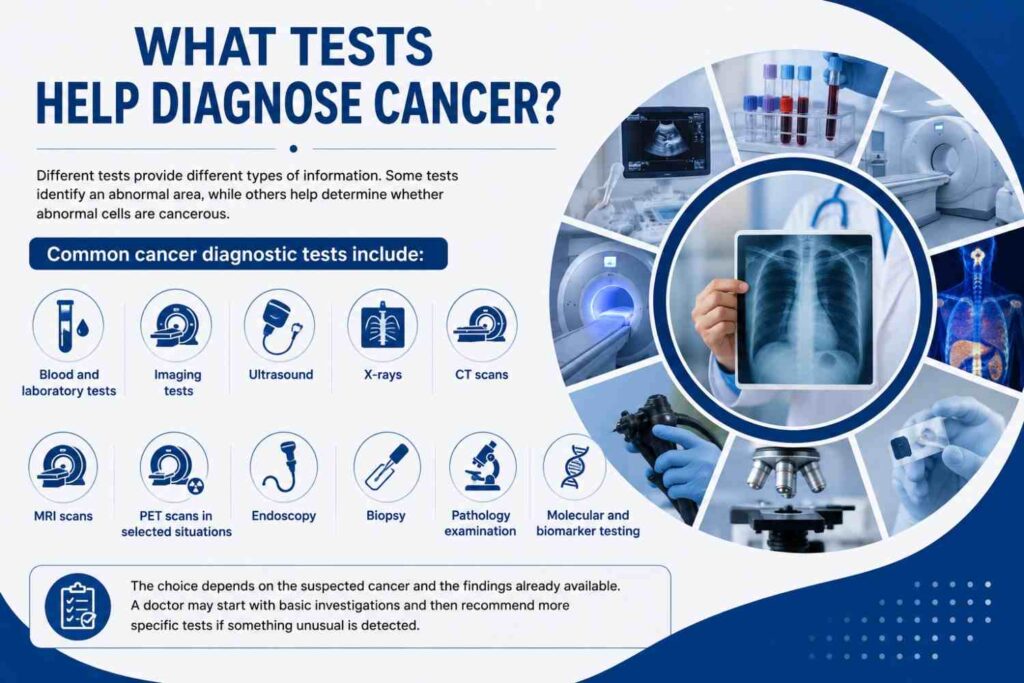
Different tests provide different types of information. Some tests identify an abnormal area, while others help determine whether abnormal cells are cancerous.
Common cancer diagnostic tests include:
- Blood and laboratory tests
- Imaging tests
- Ultrasound
- X-rays
- CT scans
- MRI scans
- PET scans in selected situations
- Endoscopy
- Biopsy
- Pathology examination
- Molecular and biomarker testing
The choice depends on the suspected cancer and the findings already available. A doctor may start with basic investigations and then recommend more specific tests if something unusual is detected.
1. Blood Tests for Cancer Diagnosis
Blood tests are among the commonly used investigations when doctors evaluate unexplained symptoms or suspected disease. They can provide information about blood cell counts, organ function, inflammation, and other changes.A complete blood count, for example, can identify abnormalities involving red blood cells, white blood cells, and platelets. Other blood tests can provide information about organs such as the liver and kidneys.Blood tests may also include certain tumor markers. These substances can sometimes be associated with particular cancers.However, tumor markers should be interpreted carefully. An elevated marker does not necessarily confirm cancer, and normal results do not always exclude it.Therefore, when asking WHAT TESTS HELP DIAGNOSE CANCER?, blood tests should generally be viewed as one part of a broader diagnostic process rather than a standalone answer.
What can blood tests help doctors understand?
Blood investigations may help doctors:
- Identify certain abnormalities
- Assess general health
- Check organ function
- Investigate possible causes of symptoms
- Monitor certain cancers after diagnosis
- Support decisions about additional testing
2. Imaging Tests
Imaging tests allow doctors to look inside the body without immediately removing tissue. They can help identify masses, unusual areas, enlarged lymph nodes, or changes in organs.Different imaging methods provide different types of information. The most suitable scan depends on the body area being investigated and the suspected condition.
Ultrasound
Ultrasound uses sound waves to create images of internal structures. It may be used to assess areas such as the abdomen, pelvis, thyroid, breast, or other soft tissues.If an ultrasound identifies an unusual finding, additional imaging or a biopsy may be recommended.
X-ray
X-rays are commonly used to examine structures such as the chest and bones. They can sometimes reveal abnormalities that require further investigation.An X-ray finding alone usually cannot establish a cancer diagnosis.
CT Scan
A CT scan produces detailed cross-sectional images of the body. It can help doctors examine organs, tissues, lymph nodes, and other structures.CT imaging may be used when a doctor needs more detailed information after an initial examination or other investigation.
MRI Scan
MRI uses magnetic fields and radio waves to create detailed images. It is particularly useful for examining certain soft tissues, the brain, spinal cord, joints, pelvis, and other body structures.The decision to use MRI depends on the suspected disease and the information required.
PET Scan
A PET scan can provide information about metabolic activity in tissues. It may be combined with CT imaging in selected cancer evaluations.PET imaging is not required for every suspected cancer. Doctors generally recommend it when the expected information may influence diagnosis, staging, or treatment planning.
3. Biopsy
A biopsy is one of the most important answers to the question WHAT TESTS HELP DIAGNOSE CANCER?During a biopsy, a sample of tissue or cells is collected and examined under a microscope. Depending on the situation, the sample may be obtained using a needle, endoscopic procedure, or surgical procedure.A biopsy can help determine whether abnormal cells are cancerous and, in many situations, identify the specific type and characteristics of the cancer.
Why is a biopsy important?
Imaging can show that an area looks suspicious, but appearance alone may not establish whether the abnormality is cancer.A tissue sample allows a pathologist to examine the cells directly.
Depending on the cancer, pathology may provide information about:
- Whether cancer is present
- The type of cancer
- Cell characteristics
- Grade or other pathological features
- Certain biomarkers
- Features that may influence treatment decisions
A biopsy is therefore often an important step when a definitive tissue diagnosis is required.
4. Endoscopy
Endoscopy allows doctors to examine the inside of certain organs using a specialized instrument with a camera.Depending on the suspected condition, procedures may include upper gastrointestinal endoscopy or colonoscopy.
Endoscopy can help identify:
- Abnormal growths
- Ulcers
- Changes in the lining of an organ
- Areas of bleeding
- Other unusual findings
If an abnormal area is identified, the doctor may collect a biopsy during the same procedure.This is particularly useful because the doctor can directly inspect the area and obtain tissue for pathology.
5. Pathology Tests
Pathology plays a central role in cancer diagnosis. After tissue or cell samples are collected, a pathologist examines them to determine whether abnormal or cancerous cells are present.Pathology may provide more detailed information than an imaging scan because it examines the actual cells or tissue.The pathology report can help the treating team understand the nature of the disease and decide what additional investigations may be necessary.For this reason, WHAT TESTS HELP DIAGNOSE CANCER? cannot be answered without considering pathology when tissue sampling is required.
6. Molecular and Biomarker Testing
Modern cancer care increasingly uses molecular testing to understand the biological characteristics of a tumor.Molecular tests can look for specific genetic changes, proteins, or other biomarkers in cancer cells.These tests may be useful in selected cancers because certain molecular characteristics can influence treatment decisions.For example, some targeted therapies or immunotherapies are considered based on particular tumor features.Molecular testing is not necessary for every person with suspected cancer. The need depends on the cancer type, pathology findings, stage, and treatment plan.
7. Screening Tests
Cancer screening is different from diagnostic testing.Screening is generally performed in people who do not have specific symptoms, with the goal of identifying certain cancers or precancerous changes earlier.
Examples may include screening approaches for:
- Breast cancer
- Cervical cancer
- Colorectal cancer
- Lung cancer in selected high-risk individuals
- Prostate-related concerns in appropriate circumstances
Screening recommendations vary according to age, personal history, family history, risk factors, and the type of cancer.An abnormal screening result does not automatically mean cancer. It usually means that further assessment may be required.
8. Tests for Different Types of Cancer
The answer to WHAT TESTS HELP DIAGNOSE CANCER? also depends heavily on the suspected cancer type.
Breast cancer
Doctors may use clinical examination, mammography, ultrasound, MRI in selected situations, and biopsy.
Lung cancer
Evaluation may involve imaging such as chest X-ray or CT, followed by additional investigations and tissue sampling when necessary.
Colorectal cancer
Colonoscopy can help examine the bowel and identify suspicious areas. Biopsy may be performed when an abnormal lesion is found.
Skin cancer
A changing mole, unusual skin growth, or persistent skin lesion may require clinical assessment and biopsy.
Blood cancers
Blood tests, bone marrow examination, imaging, and specialized laboratory or molecular investigations may be used depending on the suspected condition.
Brain and nervous system cancers
MRI or CT imaging may be used to identify abnormalities. Additional investigations, including tissue sampling, may be considered when appropriate.The diagnostic pathway is therefore individualized rather than identical for every cancer.
Causes and Risk Factors That May Lead to Testing
Doctors may recommend cancer-related investigations because of symptoms, screening findings, risk factors, or an abnormal examination.
Possible risk factors include:
- Increasing age
- Tobacco exposure
- Heavy or long-term alcohol use
- Certain inherited genetic changes
- Strong family history of specific cancers
- Previous cancer
- Certain long-term medical conditions
- Specific environmental or occupational exposures
- Some infections associated with cancer risk
- Certain lifestyle factors
Having a risk factor does not mean that a person has cancer. It simply means that the likelihood may be higher for certain cancers.A strong family history may lead to genetic counseling or a more individualized screening strategy.

Symptoms That May Lead to Cancer Testing
Certain persistent or unexplained changes may lead a doctor to recommend further investigations.
These can include:
- An unexplained lump or swelling
- Unexplained weight loss
- Persistent fatigue
- Long-lasting pain
- Unusual bleeding
- Persistent cough
- Changes in bowel habits
- Changes in bladder habits
- Difficulty swallowing
- Persistent changes in a skin lesion
- Abnormal screening results
Many of these symptoms have causes unrelated to cancer. Infections, inflammation, hormonal conditions, benign growths, and other illnesses can produce similar symptoms.The important point is persistence, progression, and the overall clinical picture.
When Should You Seek Medical Evaluation?
Persistent or unexplained symptoms should not simply be ignored. Medical assessment is particularly important when a symptom continues, becomes worse, or occurs alongside other concerning changes.
Prompt evaluation may be appropriate for:
- Unexplained bleeding
- A rapidly growing lump
- Significant unexplained weight loss
- Persistent difficulty swallowing
- Coughing up blood
- Severe or worsening unexplained pain
- New neurological changes
- Persistent symptoms with significant weakness
- An abnormal biopsy result
The urgency depends on the individual’s situation. Severe or rapidly worsening symptoms require appropriate medical attention.
Conclusion
Knowing WHAT TESTS HELP DIAGNOSE CANCER? can make the diagnostic process less confusing. Blood tests, imaging, ultrasound, CT, MRI, PET scans, endoscopy, biopsy, pathology, and molecular testing can each provide different information. No single investigation is suitable for every person or every type of cancer.The appropriate testing pathway depends on symptoms, medical history, examination findings, risk factors, screening results, and the suspected cancer. A suspicious scan or abnormal blood test does not automatically mean cancer, while a normal test may not completely rule it out.If you have persistent unexplained symptoms, an unusual lump, an abnormal screening result, or a healthcare professional has recommended specialist evaluation, following up can help identify the cause and determine whether further investigation is needed. For people seeking evaluation in Thrissur, understanding WHAT TESTS HELP DIAGNOSE CANCER? can be a useful first step toward having an informed discussion with a qualified cancer specialist. For reliable and evidence-based information about lung cancer, visit the American Cancer Society‘s guide on lung cancer.
FREQUENTLY ASKED QUESTIONS

Dr. Bibin Francis
Dr. Bibin Francis is a dedicated medical oncologist with expertise in chemotherapy, immunotherapy, targeted therapy, and personalized cancer treatment planning for a wide range of malignancies.
Jubilee Mission Medical College & Research Institute, Thrissur, Kerala